Japanese basics
Japanese i-adjectives and na-adjectives: two useful patterns
See how 温かい and 静か connect to nouns, with short examples you can use to recognize the two adjective groups.
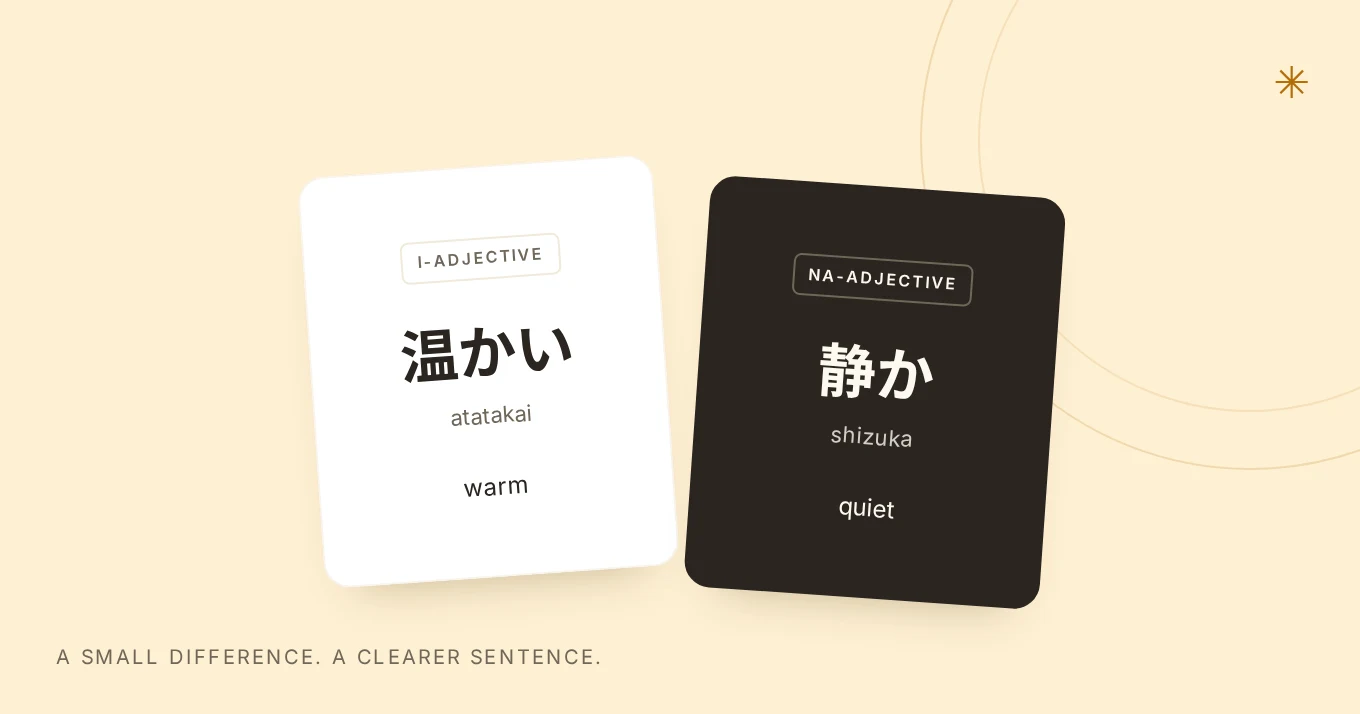
Japanese adjectives often become easier to recognize when you learn them with a noun. Start with two short phrases: warm tea and a quiet room.
温かい: an i-adjective
温かい means “warm.” Before a noun, use 温かい directly. You do not add な between this adjective and the noun.
In a polite sentence, you can say このお茶は温かいです。— “This tea is warm.” Notice that the い remains before です.
静か: a na-adjective
静か means “quiet.” Before a noun, add な. This connection is the reason learners often call this group “na-adjectives.”
At the end of a polite sentence, use 静かです: この部屋は静かです。— “This room is quiet.” The な connects the adjective to a following noun; it does not go before です.
An i sound does not always mean an i-adjective
きれい (kirei, “beautiful” or “clean”) ends in an i sound, but it belongs to the na-adjective group. A clean room is きれいな部屋. Learn the group with the word instead of relying only on its final sound.